
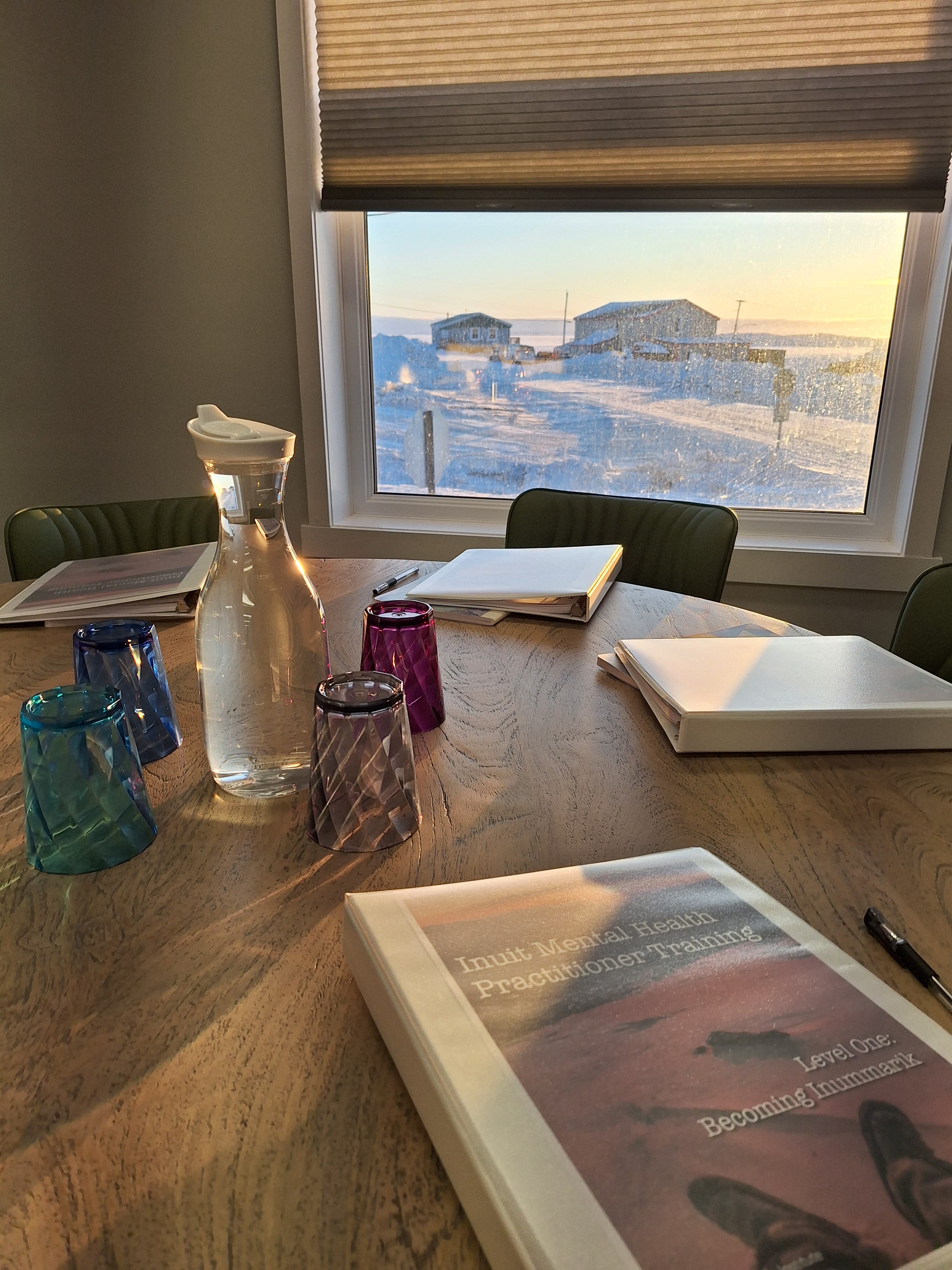
Author affiliations: Andrew Gentile is co-founder of the Mandala Institute for Holistic Mental Health. Karen Aglukark is an Inuk mental health advocate and co-facilitator of Becoming Inummarik, an Inuit-specific heal-the-healer mental health programme.
The Concept
Becoming Inummarik represents an exemplar of heal-the-healer programming, an approach addressing mental health capacity building within communities experiencing collective trauma, particularly Indigenous populations affected by colonisation. Whilst such programmes benefit frontline workers, Becoming Inummarik serves a dual purpose: providing Inuit-specific psycho-emotional education for any community member seeking to learn about mental health, improve their wellbeing, or develop skills to manage their thoughts, emotions, stress, and relationships. The underlying premise is that effective helpers need support for their own healing to avoid perpetuating harm or experiencing burnout. Inummarik is an Inuktitut word describing “a human being or an able person who can act with wisdom” (Nunavut Department of Education, 2007), and the programme goal is to support participants in becoming such people.
The programme emerged from extensive research consolidating traditional and contemporary Inuit mental health concepts into a comprehensive Inuit Mental Health Model (Gentile, 2021), developed through conversations with Inuit mental health leaders and systematic analysis of documented Inuit perspectives on mental health, woundedness, and healing. This research identified specific types of support and areas for learning that Inuit have said their communities need to heal, providing direction for curriculum development. The resulting 120-hour, three-week programme synthesises traditional and contemporary Inuit perspectives with culturally compatible Western frameworks. It combines psycho-emotional education and skill-building with exploration of traditional Inuit approaches to healing, interwoven with discussions of intergenerational and current realities affecting mental health for participants, their families, communities, and Inuit society as a whole.
Becoming Inummarik aligns with trauma-informed care frameworks, which emphasise safety and recognition of trauma’s pervasive impact (Substance Abuse and Mental Health Services Administration, 2014), and with community psychology approaches focused on empowerment, social justice, and addressing systemic inequities (Arcidiacono & Di Martino, 2016). The programme synthesises Inuit concepts, such as maintaining harmony and balance across all life aspects (Aupilaarjuk et al., 2001), with Western mental health literacy, creating what participants describe as “the best of both Inuit and non-Inuit approaches.” This theoretical grounding ensures cultural authenticity is maintained alongside the sharing of evidence-informed practices, demonstrating that, through thoughtful design, Indigenous healing traditions and Western psychological frameworks can function as complementary rather than competing paradigms.
Such compatibility is not always obvious or easily achieved. There is a fundamental mismatch between mainstream Western conceptions of mental health and more holistic Indigenous worldviews. While mainstream mental health systems primarily emphasise a Western biomedical model that often separates mind and body, and focuses on individualistic treatments, Indigenous understandings of health encompass a broader view that integrates physical, emotional, mental, spiritual, cultural, and social aspects connected to family, community, ancestry, land, and spirituality (Smye, 2004). This paradigmatic difference has profound implications: mainstream Western approaches may inadvertently communicate that individuals must learn to live with their conditions indefinitely, treatable only through medication, whereas Indigenous frameworks offer hope for genuine restoration of wellbeing by addressing root causes and restoring harmony across all aspects of life. Indigenous clients of Western-trained mental health providers often report that the support they receive does not reflect their values, culture, or lived realities, rendering it ineffective and discouraging them from continuing or seeking support in the future.
From her personal and academic experiences studying psychology at a Canadian university, co-author Aglukark has found that Western-trained professionals are often taught to view people as clients and their concerns as problems to solve. Meanwhile, communities are not facing a problem they need solved, but a gap that needs to be filled through connection, trust, and shared responsibility. After witnessing urgent mental health needs whilst working as a research and policy analyst with the Legislative Assembly of Nunavut, Aglukark left to pursue a psychology degree, only to find that approaches taught in Western academia could not prepare her to meaningfully serve fellow Inuit.
Becoming Inummarik addresses these gaps not only through the delicate work of cross-cultural curriculum building but also through a novel capacity-building model. Rather than requiring the intensive training and credentials of counsellors or therapists, the model redefines community mental health workers as programme facilitators. Many conventional mental health professions require multi-year university degrees unavailable to Inuit living in northern regions, creating systemic barriers that keep expertise and funding in non-Inuit hands. By replacing intensive out-of-community credentialing with more accessible in-community facilitator training, the model enables Inuit to deliver structured psycho-emotional education, creating pathways for meaningful participation in community mental health The programme was piloted with nine Inuit participants in 2021; three participants from that pilot then joined as programme facilitators, allowing the curriculum to evolve with continuous culturally informed input.
The Affective Dimension
The emotional architecture of Becoming Inummarik is foundational to its function and distinguishes it from conventional professional training programs, such as those for psychotherapy or social work. The programme explicitly acknowledges that communities experiencing intergenerational trauma carry substantial emotional burdens that must be addressed for individuals to effectively support one another.
The programme creates deliberate emotional safety through decolonisation pedagogy. Recognising that historical trauma related to non-Inuit authority can be triggered by perceived power dynamics, facilitators open sessions by acknowledging colonial histories and inverting traditional classroom hierarchies. Non-Inuit participants are encouraged to “hold space” for Inuit voices, and listen deeply rather than centre their own perspectives. The programme also addresses what developers term the “fishbowl effect”: the feeling of being observed and objectified, which Inuit participants often experience when outnumbered by non-Inuit participants. Coordinators are encouraged to balance participant demographics and avoid mixing workplace hierarchies, as power imbalances mute authentic emotional expression.
The group-based delivery model aligns with traditional Inuit culture, in which healing, like many aspects of traditional life, occurred in group settings where community witnessed, validated, and supported individual struggles (Aupilaarjuk et al., 2001; Minor, 1983). Each Becoming Inummarik cohort ideally comprises 8 to 12 participants who form a container of safety that evolves over the programme’s progression. This structure contrasts with Western one-on-one therapy, which reflects individualistic cultural values foreign to Inuit ways of being. Within the cohort, shared experience builds trust gradually; as safety deepens across the three weeks, participants demonstrate increasing openness, emotional expression, and unburdening, distributing emotional weight across the group rather than isolating it within the individual.
Emotional expression and self-regulation are central to the programme’s healing function. The curriculum discusses traditional Inuit practices and their potential role in facilitating self-expression and self-regulation, including katajjaq (throat singing), drumming, song duels, and storytelling. Individual sharing within the programme is encouraged, providing participants with opportunities for emotional unburdening followed by collective validation and support. The programme also encourages participants to bring handiwork to sessions, such as sewing or beading; some have shared that this helps them listen, think deeply, and connect with their emotions. Participants need not maintain constant eye contact or sit in the formal posture typical of Western therapy and are encouraged to move and settle in the space in whatever manner supports their physical comfort, which is especially important given the programme’s emotionally challenging discussions. This flexibility deepens the emotional safety of individuals and, therefore, the group experience.
The programme highlights close parallels between the Western concept of emotional intelligence and Inuit Qaujimajatuqangit principles (Inuit societal values), demonstrating that Inuit cultural wisdom has long embodied what Western psychology has only recently articulated. This framing validates traditional knowledge whilst making mental health concepts accessible through both Indigenous and Western lenses. Participants learn to recognise emotions as messengers rather than problems to suppress, developing capacity to “sit with” difficult feelings rather than immediately seeking to eliminate discomfort. This cultivation of emotional tolerance is particularly significant given widespread intergenerational trauma often manifests as emotional dysregulation (Jensen et al., 2021). Grief work forms a substantial component of the affective curriculum, though not through explicit invitation. Rather, unresolved grief from personal losses, cultural disruption, and community-level traumas including residential schools and forced relocations emerges naturally during conversations, reflecting the emotional safety created by the programme’s non-intrusive and comforting space.
The programme navigates the emotional challenges of decolonisation itself with particular nuance. Despite having seen numerous psychiatrists, psychologists, and counsellors for personal support, Aglukark reflects that it was in conversations with other Inuit during the programme that she felt truly understood. The programme helped her recognise that shame she carried about being both Inuk and non-Inuk was rooted in generational trauma, and that this shame could not be healed in one-on-one sessions with non-Inuk practitioners. Only by sharing stories with other Inuit did that shame begin to transform into self-love.
Self-examination and questioning of internalised colonial beliefs can trigger destabilisation and defensive reactions as participants’ sense of self is challenged. Facilitators acknowledge these responses as natural aspects of transformation, emphasising participant autonomy whilst validating the full spectrum of emotional responses and facilitating group support. Participants who demonstrate resistance to or discomfort with content raised during group discussions are reminded, privately, that participation is optional, emphasising their agency, emotional safety, and wellbeing.
The pedagogy intentionally counteracts the buildup of difficult emotions through actively engaging participants. Rather than passive didactic instruction that can lead to emotional overwhelm, the conversational approach invites continuous dialogue, sharing, and collaborative meaning-making. Participants consistently report feeling energised rather than depleted, even after intensive full-day sessions. This may reflect the inclusion of meditation and guided visualisations designed to release mental, emotional, and physical tension that builds up during emotionally charged conversations. For many, the programme represents the first time they have been invited to centre their own emotional experiences within an educational context. Participants describe profound shifts in their thinking, including increased understanding and reduced judgement of others. When surveyed as to whether they felt stronger mentally or emotionally after participating, almost 90 percent selected “very much so.”
Challenges and Future Directions
Several challenges constrain the programme’s reach and effectiveness. Becoming Inummarik is delivered almost exclusively in English due to the current availability of only English-speaking facilitators, and programme resources remain English-only as localised translation requires significant funding and translator capacity. The programme benefits from involvement of local knowledge keepers such as Elders, yet securing their participation can prove difficult for various reasons including availability, health, and community dynamics. Completing the full three-week curriculum poses logistical challenges for some organisations and participants, though each week offers standalone value. Experience has also demonstrated the importance of having locally based Inuit facilitators in some communities, a capacity that will take time and to develop.
There is also significant diversity within and across Inuit communities that a single programme cannot fully address. Whilst feedback has been largely positive, there is a clear need for complementary programming serving Inuit who may prefer psycho-emotional education not specifically grounded in traditional Inuit practices. For some individuals, particularly those who have adapted to other paradigms since colonisation, content centred on traditional culture can be triggering rather than healing. Acknowledging these limitations points toward future development: expanded facilitator training in Inuktitut and other regional languages, resources for meaningful Elder involvement, flexible delivery formats, and parallel programming that honours diverse pathways to wellbeing within Inuit communities.
Relevance for Practitioners and Policymakers
The Becoming Inummarik model offers critical insights for practitioners and policymakers working in diversity management, particularly those addressing historical and ongoing colonisation within organisational and societal contexts.
For mental health service delivery, the programme demonstrates that effective decolonisation requires more than superficial cultural adaptations to Western frameworks. Genuine decolonisation demands inverting power structures, centring Indigenous epistemologies, and creating pathways to expertise that do not require Indigenous peoples to leave their homelands, cultures, and communities. Policymakers should recognise that conventional credentialing systems can function as colonial barriers perpetuating inequity whilst siphoning resources away from affected communities. Traditional Inuit knowledge represents substantial intellectual work developed over millennia that warrants recognition equivalent to Western academic research.
The heal-the-healer model challenges prevailing assumptions in professional development that prioritise skill acquisition over personal healing. The programme’s three-level vision (beginning with self-healing, advancing to helping others, and culminating in community healing leadership) provides a developmental framework applicable beyond Indigenous contexts. Organisations implementing diversity and inclusion initiatives might consider whether their own practitioners carry unresolved trauma or burnout that undermines programme effectiveness.
For practitioners facilitating diversity work, the programme’s emotional safety protocols offer concrete methodologies. The fishbowl effect has direct parallels in organisational settings where minoritised employees feel scrutinised when significantly outnumbered. The practice of collectively establishing group agreements, avoiding mixing hierarchical levels in vulnerable conversations, and making participation voluntary all translate to organisational contexts. The co-facilitation model, pairing Inuit facilitators developing expertise with experienced non-Inuit facilitators, provides a capacity-building approach honouring both knowledge transfer and community ownership. This contrasts with extractive “expert” models common in organisational consulting, offering instead a sustainable pathway towards community-led programming.
Policymakers should note the programme’s documented outcomes: nearly 150 participants across 13 organisational cohorts in Nunavut, Nunavik, Ontario, and Manitoba, with consistent reports of transformative impact. These results were achieved through voluntary participation, culturally aligned content, and flexible delivery in which three programme weeks are typically spaced over a year, allowing participants time to integrate learning before proceeding. Participant feedback consistently demonstrates broader community impact, with respondents expressing hope that wider programme participation will strengthen their communities and reporting increased compassion that motivates them to support others.
For organisations and policymakers committed to reconciliation and decolonisation, Becoming Inummarik demonstrates that meaningful progress requires long-term investment in community-led, culturally grounded programming that prioritises healing alongside capacity building. As Aglukark has reflected, people give up when they feel alone, and the remedy for this is connection. Mental health strategies must focus on creating safe, culturally grounded spaces where Inuit can share their challenges, be understood, and care for one another without judgement, ensuring that no one feels alone while navigating life’s hardest moments. This represents a fundamental shift from extractive, paternalistic service delivery towards Indigenous self-determination in mental health.
References
Arcidiacono, C., & Di Martino, S. (2016). Community psychology contributions to the study of social inequalities, well-being and social justice. Psychosocial Intervention, 25(2), 67-69.
Aupilaarjuk, M., Aupilaarjuk, T., Nutaraaluk, L., Iqallijuq, R., Ujarak, J., Ijituuq, I., & Kupaaq, M. (2001). Cosmology and shamanism (B. Saladin d’Anglure, Ed.). Nunavut Arctic College. (Interviewing Inuit Elders, Vol. 4).
Gentile, A. (2021). Inuit Mental Health Model: Consolidating Inuit Knowledge on Mental Health and Mapping a Path of Healing for the Future. Unpublished manuscript. Available at: https://www.academia.edu/70146254/Inuit_Mental_Health_Model_Consolidating_Inuit_Knowledge_on_Mental_Health_and_Mapping_a_Path_of_Healing_for_the_Future (accessed 13 December 2025).
Jensen, S.K.G., Sezibera, V., Murray, S.M., Brennan, R.T., & Betancourt, T.S. (2021). Intergenerational impacts of trauma and hardship through parenting. Journal of Child Psychology and Psychiatry, 62(8), 995-1005.
Minor, N.K. (1983). A review of counseling among cultures with emphasis upon culture-specific counseling within the Inuit society: A method and training program [Doctoral dissertation, University of Massachusetts Amherst].
Nunavut Department of Education. (2007). Inuit Qaujimajatuqangit: Education framework for Nunavut curriculum. Government of Nunavut. https://www.gov.nu.ca/sites/default/files/publications/2024-01/Inuit%20Qaujimajatuqangit%20ENG.pdf
Smye, V. (2004). The Nature of the Tensions and Disjunctures between Aboriginal Understandings of and Responses to Mental Health and Illness and the Current Mental Health System [Doctoral dissertation, University of British Columbia].
Substance Abuse and Mental Health Services Administration. (2014). SAMHSA’s Concept of Trauma and Guidance for a Trauma-Informed Approach (HHS Publication No. SMA 14-4884). Rockville, MD: Author.
